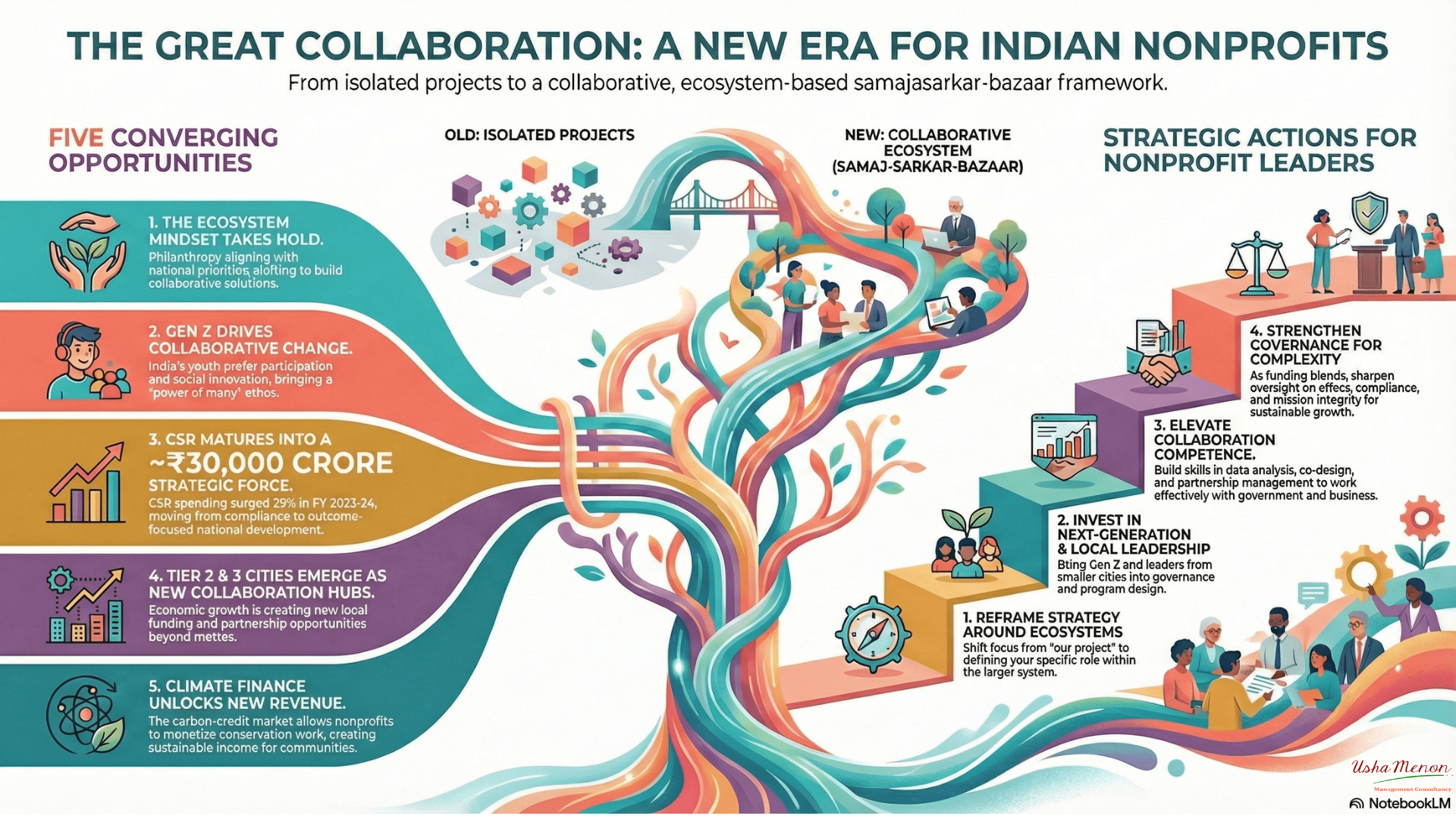
Nonprofit boards and leaders in India are entering 2026 in a context of converging opportunities: a stronger ecosystem mindset, a confident young population, a maturing CSR landscape, the rise of new geographies, and climate-linked finance. When read together, these trends demand that social purpose organisations and nonprofits move from program-centric decision-making to ecosystem, partnership, and impact-centric leadership.
For decades, the term “NGO” (non-governmental organisation) has shaped how these entities see themselves and are perceived by others. Yet, it has always been a misnomer that defines them by what they are not - ‘non-state entities’, rather than by the social value they create for communities and the country. While historically positioned as separate from, or even in opposition to, the state, they were often dependent on funding from foreign governments such as USAID and DFID/FCDO, while still calling themselves non-governmental.
In today’s context, however, such a stance is increasingly limiting. Social-purpose organisations must consciously reframe their identity and practice, recognising public, private, and people sectors as collaborators and co-creators of solutions that bridge gaps in people’s wellbeing, planetary health, and public policy. This reframing asks boards and leaders to move beyond an “us versus them” narrative and instead embrace the roles as convener, innovator, implementation partner, and community voice, within a ‘samaj-sarkar-bazaar’ (society-state-market) framework that reflects the complexity and interdependence of India’s development challenges.
1. Ecosystem mindset and the vision of ‘Viksit Bharat’
The Viksit Bharat (Developed India) by 2047, vision has accelerated a shift from isolated philanthropy to ecosystem-building, with philanthropists aligning their portfolios to national development priorities in health, education, livelihoods, arts, and sports. Increasingly, they are investing in research, community mapping, and strengthening organisations that convene multiple stakeholders, so that solutions are “fit for purpose” and designed with those closest to the problem being addressed.
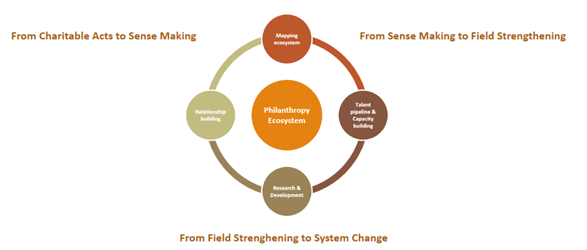
Examples of samaj-sarkar-bazaar collaborations include:
• India’s Digital Public Infrastructure (DPI) is now being adopted globally as a blueprint for inclusive development and financial inclusion in developing countries.
• Philanthropic and CSR-backed partnerships with schemes such as Swachh Bharat, Smart Cities Mission, Khelo India, and National Health Mission, where non-profits deliver ground-up engagement and last-mile implementation, while the state provides scale.
• Multi-stakeholder alliances in skills development, employability, and sports that bring together family philanthropies, corporates, schools, youth, livelihood, and education-focused nonprofits, and local governments to advance youth well-being, employment and national sports goals.
Implications to consider:
• Move strategy conversations from “our project” to “our role in the ecosystem”, explicitly mapping relevant nonprofit collaborators, government schemes, CSR players, social enterprises, and community institutions in your thematic and geographic area.
• Invest in capabilities around data, learning, and collaboration management, so that your organisation can credibly sit at the table with government (schemes and public sector enterprise) and corporate sector, as an implementation or innovation partner.
2. Gen Z’s collaborative localism
The Covid-19 years exposed Indian youth to both the fragility and the necessity of strong institutions, deeply shaping how they now choose to engage with the country’s future. Gen Z in India is signalling a strong preference for progress through participation and social innovations. They increasingly believe that reform does not require riots and public outrage. They are comfortable straddling roles, as professionals, social entrepreneurs, volunteers, creators, and donors, bringing a “power of many” ethos to their community engagement and philanthropy alike.
• EcoSattva Environmental Solutions’ work on solid waste management and Kham River restoration in Sambhajinagar (formerly Aurangabad) combines community mobilisation, municipal contracts, and global climate recognition, demonstrating how local action can scale systemically.
• Young India Philanthropic Pledge and similar next-gen giving platforms, where young wealth-holders and professionals pledge resources and co-create solutions together, signalling a shift from solitary giving to collaborative, peer-driven philanthropy.
• India Volunteering Quotient 2025 found that 222 Indian companies tracked were clocking 31% workforce participation in volunteering
Implications that nonprofit leaders should consider:
• Design initiatives that allow youth to co-own social solutions, through participatory design, micro-giving circles, digital campaigns, and visible leadership opportunities in programmes and events.
• Intentionally create advisory or innovation councils that include youth and young professionals from your communities to help envision and resource addressing the outcomes and impact that you champion.
• Provide feedback and transparent impact dashboards so that skills-based and general volunteers, donors, influencers and advocates for your cause can see how their actions translate into tangible change, reinforcing trust and turning one-off engagement into a sustained relationship with the cause.
3. CSR’s maturing landscape
More than a decade into India’s CSR mandate, the space is maturing from compliance-oriented grant making, to more strategic, outcome-focused investments, including emerging causes like climate, urban resilience, and ecosystem restoration. India’s CSR ecosystem is no longer just about the 2% as per regulation; it is rapidly evolving into a strategic investment, driving inclusive and measurable impact. Corporates are demanding clearer impact data, stronger governance, and long-term partnerships, while also being pushed by ESG regulations and stakeholder expectations to do good and do it well. CSR is no longer charity, it a vital tool is nation-building.
Evolving trends include:
• A shift from one-off donations to multi-year, co-created programmes where nonprofits act as implementation partners, innovation labs, and community engagement specialists.
• In FY 2023–24, India’s CSR spending touched ~₹30,000 Crore, marking a 29% surge driven by economic performance, stronger compliance and voluntary corporate leadership. 57% of companies exceeded their CSR obligation and 380 non-mandated companies contributed ₹800+ crore voluntarily. The average actual CSR spend per company increased to INR 59 crore in FY 2024-25 from INR 26 crore in FY 2015-2016.
• Nonprofits remain the backbone of CSR implementation, with ~74% of CSR projects executed through them. Tier-2 cities saw 55% growth in funding (FY22–24)
• CSR investments in urban sustainability, waste management, water security, biodiversity, inclusive skilling, education, and health outcomes, leveraging on ‘capital-stacking’ aligned with Smart Cities, AMRUT, and other government missions.
• Anecdotal examples from fundraising leaders in India have indicated a high degree of success in partnering with state governments (formalised through an MoU) to effectively implement State and Central Government schemes.
• This ‘capital-stacking’ approach is whereby the project management and facilitation cost is invested by donors, and the programme cost invested by the Government. This offers high leverage in terms of the amount invested by the donors and the return in terms of the programme amount invested by the government (1:30 where every rupee invested yields a return of 30 rupees.)
Implications that nonprofit leaders should consider:
• Review relationships with the corporate sector, from short-term project funding to multi-year systemic change outcomes.
• Strengthen your organisation’s capacity in full-cost accounting, impact measurement, financial transparency, and risk management to meet the due diligence expectations of serious CSR and ESG investors.
• Proactively curate partnership propositions that align your mission with a corporate’s core business, geography, and sustainability priorities, moving from “fund us” to “let us design impact together”
4. Tier 2 and 3 cities as collaboration hubs
Economic growth, industrialisation, and infrastructure improvements are rapidly strengthening Tier 2 and Tier 3 cities across India, where new wealth creators, Micro-Small- Medium Enterprises (MSMEs), and mid to large corporates are emerging. Improved connectivity and digital penetration make it easier for local citizens, the Indian diaspora, and businesses to support community-rooted organisations without always routing funds through metro-based NGOs and entities.
This shift is visible in:
• Growing CSR and philanthropic investments in non-metro cities as companies expand operations and supply chains beyond the traditional hubs.
• Local nonprofits and social enterprises in these cities stepping into roles as convenors across health, education, skilling, arts, environment, and sports, often in partnership with the Corporate sector, municipal bodies and district administrations.
Implications that nonprofit leaders should consider:
• If you are based in a tier 2 or tier 3 city, position your organisation as the “go-to” impact partner for local industry, chambers of commerce, and high-net-worth families, with clear, credible local impact propositions.
• If you are a pan-India, or metro-based organisation, explore intentional partnerships with credible nonprofit organisations in smaller cities, respecting their contextual expertise while offering technical support, fundraising access, and cause advocacy and awareness engagement.
5. Carbon-credit economy and nature-positive work
Back in India’s Carbon Credit Trading Scheme (CCTS) and broader climate commitments are paving the way for a more structured carbon market, with nature-based solutions and biodiversity conservation gaining prominence. Corporates and investors are increasingly looking for high-quality projects in reforestation, agroforestry, soil health, watershed management, and biodiversity restoration to meet decarbonisation and ESG goals.
For nonprofits working with farmland, forests, and biodiversity, this creates:
• Opportunities to design carbon projects, such as climate-smart agriculture, regenerative practices, and community-managed forests, that can generate tradable credits and long-term income streams for communities.
• Focus on the need for robust baselines, MRV (measurement, reporting and verification), and legal frameworks to ensure that communities retain fair benefits and that projects meet emerging national and global standards.
• By monetising the climate value of their conservation work, the social-purpose organisations can channel this revenue directly into community resilience efforts.
Implications that nonprofit leaders should consider:
• Explore whether and how your environmental or livelihoods programmes can be structured as carbon or biodiversity credit projects, in partnership with specialist intermediaries.
• Put in place strong governance safeguards on consent, benefit-sharing, and long-term risk so that communities are not exposed to volatile markets or inequitable contracts.
Turning trends into strengthened impact
To ensure these five trends genuinely strengthen your organisation and deliver impact, boards, trustees and management can take the following integrated actions:
• Reframe strategy around ecosystems: Explicitly articulate your organisation’s role within the larger samaj-sarkar-bazaar system, and set partnership goals alongside programme goals.
• Invest in next-gen and local leadership: Bring Gen Z change-makers and leaders from tier 2 and 3 cities into governance, advisory roles, and programme design, ensuring that your leadership reflects India’s future.
• Build climate and finance literacy: For organisations in agriculture, environment, or rural development, build board-level understanding of carbon markets, climate risk, and nature-based solutions, and co-create and pursue expert-guided programmes.
• Elevate collaboration competence: Treat collaboration as a core organisational competency by developing skills in co-design, data analysis, joint fundraising, and conflict resolution together with government and private-sector partners.
• Strengthen nonprofit governance for complexity: As funding becomes more blended (CSR, philanthropy, carbon finance, government schemes), sharpen oversight on ethics, community voice, compliance, and long-term sustainability, so that growth does not dilute your mission.
When nonprofit boards and management teams approach the future with an ecosystem lens, a readiness to partner across generations and sectors, and a disciplined focus on governance and learning, these trends can move from being external forces to becoming strategic levers that deepen and sustain impact for the communities and causes that the organisation serves.
-min.png)